Wednesday, 16 June 2010

Hoplite - Warfare

This very interesting article describing how hoplites were fighting can be found on Wikipedia.

The fragmentary nature of Ancient Greece, with many competing city-states, increased the frequency of conflict, but conversely limited the scale of warfare. Limited manpower did not allow most Greek city-states to form large armies which could operate for long periods, especially in the case of light troops like the psiloi, who were recruited from the lower citizen classes, and as such, they were mainly farmers, workers, even slaves. This inevitably reduced the potential duration of campaigns, as a large portion of any Greek army would need to return to their own professions (especially in the case of farmers, for example). Campaigns would therefore often be restricted to summer. Armies marched directly to their target, the battlefield having possibly already been agreed on by the contestants.

If battle was refused by the defender, they would generally retreat to their city, in which case the attackers generally had to content themselves with ravaging the surrounding countryside, since siegecraft was not efficient, at least until the 5th century BC. When battles occurred, they were usually set piece and intended to be decisive. The battlefield would be flat and open to facilitate phalanx warfare. These battles were usually short and required a high degree of discipline. At least in the early classical period, cavalry was usually used to protect the flanks, when present at all, and cover a possible retreat. Light infantry and missile troops took part in the battle, but their role was of a lower importance.


The phalanxes would approach each other in a steady, slow march to keep cohesion or rarely at a run, if the enemy was prone to panic, or if they fought against enemies equipped with bows, as was the case against the Persians at the Battle of Marathon.

 
Individual hoplites carried their shields on their left arm, protecting not only themselves but also the soldier to the left. This meant that the men at the extreme right of the phalanx were only half-protected. In battle, opposing phalanxes would exploit this weakness by attempting to overlap the enemy's right flank. It also meant that, in battle, a phalanx would tend to drift to the right (as hoplites sought to remain behind the shield of their neighbour). The most experienced hoplites were often placed on the right side of the phalanx, to counteract these problems. A phalanx tended to be 8 rows or more deep, each row with a leader, and a rear rank officer, the ouragos (meaning: tail-leader), who kept order in the rear.

The two lines would remain at a small distance to be able to effectively use their spears, while the psiloi threw stones and javelins from behind their lines. If the "doratismos" (Greek for spear combat) was not decisive, then the lines would close and swords would be drawn. The shields would clash and the first lines (protostates) would stab at their opponents, at the same time trying to keep in position. The ranks behind them would support them with their own spears and the mass of their shields gently pushing them, not to force them into the enemy formation but to keep them steady and in place. At certain points, a command would be given to the phalanx or a part thereof to collectively take a certain number of steps forward (ranging from half to multiple steps). This was the famed "othismos".


At this point, the phalanx would put its collective weight to push back the enemy line and thus create fear and panic among its ranks. There could be multiple such instances of attempts to push, but it seems from the accounts of the ancients that these were perfectly orchestrated and attempted organized en masse.

The phalanx is an example of a military formation in which single combat and other individualistic forms of battle were suppressed for the good of the whole. In earlier Homeric combat, the words and deeds of supremely powerful heroes turned the tide of battle. With his friends jostling and pushing on both sides and behind, and his enemies forming a solid wall in front of him, the hoplite had little opportunity for feats of technique and weapon skill, but great need for commitment and mental toughness. The hoplites had to trust their neighbours for mutual protection, so a phalanx was only as strong as its weakest elements. Its effectiveness depended on how well the hoplites could maintain this formation while in combat, and how well they could stand their ground, especially when engaged against another phalanx. The more disciplined and courageous the army, the more likely it was to win – often engagements between the various city-states of Greece would be resolved by one side fleeing before the battle. The Greek word dynamis, the "will" or "ability to fight," was used to express the drive that kept hoplites in formation.


Battles rarely lasted more than an hour. Once one of the lines broke, the troops would generally flee from the field, sometimes chased by psiloi, peltasts or light cavalry. If a hoplite escaped, he would sometimes be forced to drop his cumbersome aspis, thereby disgracing himself to his friends and family (becoming a "ripsaspis", one who threw his shield). Casualties were slight compared to later battles, rarely amounting to more than 5% of the losing side, but the slain often included the most prominent citizens and generals who led from the front. Thus, the whole war could be decided by a single field battle; victory was enforced by ransoming the fallen back to the defeated, called the "Custom of the Greeks".


Ancient Greek warfare

Ancient Greek warfare

This is a short version of articles from Wikipedia.

The fragmentary nature of Ancient Greece, with many competing city-states, increased the frequency of conflict, but conversely limited the scale of warfare. Unable to maintain professional armies, the city-states relied on their own citizens to fight. This inevitably reduced the potential duration of campaigns, as citizens would need to return to the own professions (especially in the case of farmers). Campaigns would therefore often be restricted to summer. Armies marched directly to their target, possibly agreed on by the protagonists. 

The battlefield would be flat and open, reducing the possibilities for complex tactical maneuvers. These battles were short, bloody, and brutal, and thus required a high degree of discipline. At least in the early classical period, other troops than hoplites were less important; (cavalry) generally protected the flanks, when present at all; and both light infantry and missile troops were negligible. The most famous tactic from these times was hoplite phalanx.

The model for the hoplite army evidently quickly spread throughout Greece. The persuasive qualities of the phalanx were probably its relative simplicity (allowing its use by a citizen militia), low fatality rate (important for small city-states), and relatively low cost (enough for each hoplite to provide their own equipment). The Phalanx also became a source of political influence because men had to provide their own equipment in order to be a part of the army.


The scale and scope of warfare in Ancient Greece changed dramatically as a result of the Greco-Persian Wars. To fight the enormous armies of the Achaemenid Empire was effectively beyond the capabilities of a single city-state. The eventual triumph of the Greeks was achieved by alliances of many city-states (the exact composition changing over time), allowing the pooling of resources and division of labour. 


One of the most famous battles of the Greco-Persian Wars was battle of Marathon. An Athenian army of 10,000 hoplites won against Persian army of 20-60,000. Tactically, the hoplites were very vulnerable to attacks by cavalry, and the Athenians had no cavalry to defend the flanks. However Persians didnt use this advantage and lost. This was the first true engagement between a hoplite army and a non-Greek army. The Persians had acquired a reputation for invincibility, but the Athenian hoplites proved crushingly superior in the ensuing infantry battle.


Ten years later Persians Came back with 150,000-250,000 men. Many polis-states united and formed an anti-Persian league. The visionary Athenian politician Themistocles had successfully persuaded his fellow citizens to build a huge fleet to combat the Persian threat (and thus to effectively abandon their hoplite army, since there were not men enough for both). Amongst the allies therefore, Athens was able to form the core of a navy, whilst other cities, including of course Sparta, provided the army. The use of such a large navy was also a novelty to the Greeks.

The second Persian invasion is famous for the battles of Thermopylae and Salamis. As the massive Persian army moved south through Greece, the allies sent a small holding force (10,000) men under the Spartan king Leonidas, to block the pass of Thermopylae whilst the main allied army could be assembled. The allied navy extended this blockade at sea, blocking the nearby straits of Artemisium, to prevent the huge Persian navy landing troops in Leonidas's rear. Famously, Leonidas's men held the much larger Persian army at the pass (where their numbers counted for nothing) for three days, the hoplites again proving their superiority. Only when a Persian force managed to outflank them by means of a mountain track was the allied army overcome; but by then Leonidas dismissed the majority of the troops, remaining with 300 Spartans (and perhaps 2000 other troops) to guard the pass, in the process making one of history's great last stands. The Greek navy, despite their lack of experience, also proved their worth holding back the Persian fleet whilst the army still held the pass.


The Athenians navy defeated huge Persians Navy under Salamis and a united Greek army of 40,000 hoplites decisively defeated them at the Battle of Plataea, effectively ending the invasion. Warfare in Greece had moved beyond the seasonal squabbles between city-states, to coordinated international actions involving huge armies. The ambitions of many Greek states had dramatically increased, and the tensions resulting from this would lead directly onto the Peloponnesian War.


The Peloponnesian War (431-404 BC), was fought between the Athenian dominated Delian League and the Spartan dominated Peloponnesian League. Building on the experience of the Persian Wars, the diversification from core hoplite warfare, permitted by increased resources, continued. There was increased emphasis on navies, sieges, mercenaries and economic warfare. In the aftermath, the Spartans were able to establish themselves as the dominant force in Greece for three decades.

Although tactically there was little innovation in the Peloponessian War, there does appear to have been an increase in the use of light infantry, such as peltasts (javelin throwers) and archers. Many of these would have been mercenary troops, hired from outlying regions of Greece. Nevertheless, it was an important innovation, one which was developed much further in later conflicts.


The first major challenge to the Spartan hegemony occurred in the Corinthian War (395-387 BC). Sensing the Spartan weakness, an alliance of Athens, Thebes, Corinth and Argos, supported by the Persians, sought to escape from the hegemony, and increase their own influence. The early encounters, at Nemea and Coronea were typical engagements of hoplite phalanxes, resulting in Spartan victories. However, the Spartans suffered a large setback when their fleet was wiped out by a Persian Fleet. At the Battle of Lechaeum, an Athenian force composed mostly of light troops (e.g. peltasts) defeated a Spartan regiment.


The Athenian had their troops make repeated hit and run attacks on the Spartans, who, having neither peltasts nor cavalry, could not respond effectively. The defeat of a hoplite army in this way demonstrates the changes in both troops and tactic which had occurred in Greek Warfare. Peltasts became the main type of Greek mercenary infantry in the 4th century BC. Their equipment was less expensive than traditional hoplite equipment and would have been more readily available to poorer members of society.

When faced by hoplites peltasts operated by throwing javelins at short range. If the hoplites charged they would flee. As they carried considerably lighter equipment than the hoplites they were usually able to evade successfully, especially in difficult terrain. They would then return to the attack once the pursuit ended, if possible taking advantage of any disorder created in the hoplites' ranks. When fighting other types of light troops, peltasts were able to close more aggressively in melee as they had the advantage of possessing shields, swords, and helmets.
 
The Athenian general Iphicrates destroyed a Spartan phalanx in the Battle of Lechaeum in 390 BCE, using mostly peltasts. Ultimately the preceding decade, severely weakened many Greek states, and left them divided and without the leadership of a dominant power.


Although by the end of the Theban hegemony the cities of Greece were severely weakened, they might have risen again had it not been for the ascent to power of the Macedonian kingdom in the north of Greece. Unlike the fiercely independent (and small) city-states, Macedon was a tribal kingdom, ruled by an autocratic king, and importantly, covering a larger area. Once firmly unified, and then expanded, by Phillip II, Macedon possessed the resources that enabled it to dominate the weakened and divided states in southern Greece. Between 356-342 BC Phillip conquered all city states in the vicinity of Macedon, then Thessaly and then Thrace.

Finally Phillip sought to establish his own hegemony over the southern Greek city-states, and after defeating the combined forces of Athens and Thebes, the two most powerful states, at the Battle of Chaeronea in 338 BC, succeeded. Now unable to resist him, Phillip compelled most of the city states of southern Greece (including Athens, Thebes, Corinth and Argos; but not Sparta) to join the Corinthian League, and therefore become allied to him.

This established a lasting Macedonian hegemony over Greece, and allowed Phillip the resources and security to launch a war against the Persian Empire. After his assassination, this war was prosecuted by his son Alexander the Great, and resulted in the takeover of the whole Achaemenid Empire by the Macedonians. A united Macedonian empire did not long survive Alexander's death, and soon split into the Hellenistic kingdoms of the Diadochi (Alexander's generals). However, these kingdoms were still enormous states, and continued to fight in the same manner as Phillip and Alexander's armies had. The rise of Macedon and her successors thus sounded the death knell for the distinctive way of war found in Ancient Greece; and instead contributed to the 'superpower' warfare which would dominate the ancient world between 350-150 BC.

One major reason for Phillip's success in conquering Greece was the break with Hellenic military traditions that he made. With more resources available, he was able to assemble a more diverse army, including strong cavalry components. He took the development of the phalanx to its logical completion, arming his 'phalangites' (for they were assuredly not hoplites) with a fearsome 6 m (20 ft) pike, the 'sarissa'. Much more lightly armoured, the Macedonian phalanx was not so much a shield-wall as a spear-wall. The Macedonian phalanx was a supreme defensive formation, but was not intended to be decisive offensively; instead, it was used to pin down the enemy infantry, whilst more mobile forces (such as cavalry) outflanked them.

Tactical innovations included adaptations of the latest tactics applied to the traditional Greek phalanx by men such as Epaminondas of Thebes (who twice defeated the Spartans), as well as coordinated attacks (early combined arms tactics) with the various arms of his army — the phalanx, cavalry, missile troops, and (under Alexander III) siege engines. For the first time in Greek warfare cavalry became a decisive arm in battle. This 'combined arms' approach was furthered by the extensive use of skirmishers, such as peltasts.


Monday, 14 June 2010

Helms


All pictures and articles on this page are from HERE
 

Corinthian: The Corinthian helmet, originated in ancient Greece, developed in the 8th century BC, and took its name from the city-state of Corinth. It is generally accepted as the first Greek Helmet designed, based on archeological evidence. It was made from a single piece of bronze, adapted individually for each warriors. However, because of the large portion of metal covering the face, it severally limited the wearer's critical senses of vision and hearing. So, through the years, it was modified and upgraded to be more effective. The style gave way to the more open Chalcidian and Thracian helmets that provided more visability and better hearing, and the much simpler Pilos type, which was less detailed and required less bronze, making it cheaper and easier to manually produce in large quantities.

Out of combat, soldiers would often wear the helmet tipped upward for comfort. This practice rise to the pseudo-Corinthian / Apulian Corinthian type in Italy, with the characteristic nose guard and eye slits becoming mere decorations on its face, since the helmet was no longer pulled over the face but worn cap-like.


The Corinthian helmet was depicted on more sculpture and pottery than any other helmet. It went out of favour in Greece in the 5th century BC, but was adopted elsewhere, particularly in Italy and continued for hundreds of years, although changed in some ways , until mid Roman Republican times.


Chalcidian: It was especially popular in Greece in the 4th and 5th centuries BC. It was also worn extensively in the Greek (Southern) parts of Italy in the same period. The helmet is so-called because it was first, and is most commonly, depicted on pottery once thought to derive from the Euboean city of Chalcis. In fact, it is no kwon whether the helmet actually originated in Chalcis; indeed, it is no known whether the pottery in question was actualy Chalcidian.

The helmet appears to have been a development oh the Corinthian helmet, its improvements in design giving the wearer better hearing and vision, resulting in a lighter and less bulky helmet. It was made of bronze, and it consisted of a hemispherical dome, and below that, generally inset from the top dome, a pair of cheek pieces and a neck guard, with a substantial loop on either side for the wearer's ears. In the front, between the two cheek pieces, was a small nasal bar to protect the wearer's nose. The helmet could be entirely one piece, or the cheek pieces could be attached separately by hinges, which eased construction and made putting the helmet on easier. The helmet would commonly have a hole pierced on each cheek piece or elsewhere in order to accept an inner lining which was made of leather. Adornments such as combs and other protruberances were usually placed on the top of the helmet. It was often decorated with lines or more complex drawings.

The helmet is thought to have developed in turn into the Attic Helmet, a Chalcidian sub-type, which is iconic of classical soldiers. It was similar to the Chalcidian helmet but lacked a nose-guard. In fact no examples of this type of helmet have been found in Greece let alone in Athens. In Greece the Corinthian and Phrygian types were mostly used. This type of helmet was used by the Greeks in their colonies in Southern Italy, were most examples have been found, and was copied by the people who lived there, including the early Romans; so some of the Roman Republican helmets are based on this type as well as being based on the Beotian helmet.


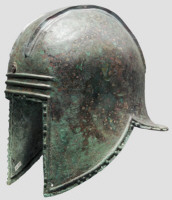
Illiryan: This type originated in ancient Greece from the Peloponnese in around 7th century BC. It is so named due to a large number of early finds coming from Illyria. Judging from archaeological evidence, the helmet was an evolution of the Kegel type of the archaic era found in Argos. It was a bronze helmet made by two pieces joined together at the crown. Two ridges running along either side of the seam provided an extra protection. In its later styles, it covered the entire head and neck, and it was open faced in all of its varieties. The Illyrian helmet did not obstruct the wearer's critical senses of vision though the first varieties hampered hearing.


Pilos: The Pilos type helmet was made in the same shape as the felt o leather travelling hat common in Ancient Greece, named Pilos. It was made from bronze and it has a conical shape. It probably originated from Lakonia. The Pilos helmet was extensively adopted by the Spartan army in the 5th century BC and worn by them until the end of the Classical era. It was less expensive and easier to manufacture than other helmet types since it required less bronze and it was less detailed. It did not obstruct the wearer's critical senses of vision and hearing.


Phrygian: This type was originated in Classical Greece and was widely used in Thrace, Dacia, Italy and the Hellenistic world until well into the Roman Empire. Is received its name due to its resemblance to the Phrygian cap.


Thracian: It was developed in the 5th century BC, and was based on a form of cap worn in Thrace, made of a soft material most often rising to a forward pointing peak. It was re-enforced by a band or hem running across the head. The helmet repeated this from in bronze.


Hoplite - different types of hoplites


I'm not a historian but I think we can distinguish 4 main types of hoplites.
  1. Classic Hoplite - heavy infantry
  2. Ekdromoi - light hoplite (support unit)
  3. Ifkratican Hoplite - reformed hoplite (light hoplite with a longer spear and smaller shield)
  4. Macedonian Phalangites - Macedonian hoplite (hoplite with a long pike and small shield)
 A hoplite is nothing more than a heavy armed and armoured foot-soldier, but the Greek armies depended on them as they formed the feared phalanx. Later on the Greek armies got more versatile as light infantry, the peltasts, and cavalry were added, but the hoplite remained by far the most important unit.


Classic Hoplite


The most common, known by everyone and used around the whole Greece was a  heavy infantry hoplite. Hoplite armor was the most sophisticated of its time and would only be bested by the armor of the Roman Legionnaires.

(Source: Wikipedia)
A hoplite was primarily a free citizen who was usually individually responsible for procuring his armour and weapon. In most Greek city-states, citizens received at least basic military training, serving in the standing army for a certain amount of time. They were expected to take part in any military campaign when they would be called for duty. The Lacedaemonian citizens (Sparta) were renowned for their lifelong combat training and almost mythical military prowess, while their greatest adversaries, the Athenians, were exempted from service only after the 60th year of their lives.


Each hoplite provided his own equipment. Thus, only those who could afford such weaponry fought as hoplites; as with the Roman Republican army it was the middle classes who formed the bulk of the infantry. Equipment was not standardised, although there were doubtless trends in general designs over time, and between city-states. Hoplites had customized armour, and possibly family symbols on his shield. The equipment might well be passed down in families, since it would have been expensive to manufacture.


Hoplites generally armed themselves just before battle. Hoplite equipment ranged from light to heavy – the total weight of a set of heavy bronze breastplate armour was around 22–27 kilograms (49–60 pounds). The body was protected by a cuirass, cuirasses typically ranged from the super expensive bronze-jointed cuirass to the relatively common tunic with many layers of canvas glued to it.


A more well-to-do hoplite would have linothorax, armour composed of stitched/laminated linen fabrics that was sometimes reinforced with animal skins and/or bronze scales. Most cuirasses where customized, which often contributed to confusion on the battlefield. The linothorax was the most popular type armour worn by the hoplites, since it was cost-effective and provided decent protection. The average farmer-peasant hoplite typically wore no armour, carrying only a shield, a spear, and perhaps a helmet plus a secondary weapon.


 The richer upper-class hoplites typically had a bronze breastplate of either the bell or muscled variety, a bronze helmet with cheekplates, as well as greaves and other armour. Greaves were the leg protection and were made to conform to the legs and leg muscles of the user (source).


The design of the helmets used varied through time. The Corinthian helmet was at first standardised and was a very successful design. Later variants included the Chalcidian helmet, a lightened version of the Corinthian helmet, and the very simple Pilos helmet worn by the later Spartan hoplites. The crests on the helmet differed for each city-state. The Thracian helmet had a huge visor to further increase protection.

Skins made by King Louise Assurbanipal for TW
 
Hoplites carried a circular shield called an aspis (often referred to as a hoplon) made from wood and covered in bronze, measuring roughly 1 metre in diameter. It spanned from chin to knee and was very heavy. It weighed 8–15 kg (17.6–33 pounds)

The primary weapon was a spear called a dory. Although accounts of its length vary, it is usually now believed to have been seven to nine feet long (~2.1 – ~2.7m). It was held one-handed, the other hand holding the hoplite's shield. The spearhead was usually a curved leaf shape, while the rear of the spear had a spike called a sauroter ('lizard-killer') which was used to stand the spear in the ground (hence the name). It was also used as a secondary weapon if the main shaft snapped, or for the rear ranks to finish off fallen opponents as the phalanx advanced over them.

Skins made by King Louise Assurbanipal for TW

Hoplites also carried a short sword called a xiphos. The short sword was a secondary weapon, used if or when their spears were broken or lost, or if the phalanx broke rank. The xiphos usually has a blade around 2 feet (0.61 m) long, however those used by the Spartans were often only 12–18 inches long. This very short xiphos would be very advantageous in the press that occurred when two lines of hoplites met, capable of being thrust through gaps in the shieldwall into an enemy's unprotected groin or throat, while there was no room to swing a longer sword.

Hoplites could also alternatively carry the curved kopis, a particularly vicious hacking weapon. Spartan hoplites were often depicted using a kopis, instead of the xiphos, in Athenian art, as the kopis was seen as a quintessential "bad guys" weapon in Greek eyes.

After the Macedonian conquests of the 4th century BC, the hoplite was slowly abandoned in favour of the phalangite, armed in the Macedonian fashion, in the armies of the southern Greek states.


Ekdromoi


The northern Polises began to use a type of hoplite that wore little or no armor called an Ekdromoi, these light hoplites however were not wide spread and the Greek military as a whole did not change. In the period between the end of the Persian Wars and the Peolponnesian War the Greek army went under drastic change: Ekdromoi became wide spread, javelin-throwing troops became commonplace, and mercenaries were beginning to form large parts of the main armies. The hoplites themselves went under changes such as: lighter armor, slightly wider shields, and more practical helmets (source).


The Ekdromos (plural Ekdromoi) was the name of the Greek light hoplites that could break away from tight formation and chase or fend off enemy peltasts. The name means 'out-runners', and denotes their ability to exit the phalanx and fight in an irregular order, as the situation might demand. The Ekdromoi were mostly lightly armoured (with aspis and bronze helmet), fast infantry and were armed with spear and short sword. The term will actually describe any hoplite who practices the tactic of Ekdromi, that is the irregular exit from the battleline.


 Spartan Ekdromoi
When within the phalanx, they functioned as ordinary hoplites but upon order, they would exit their ranks and attack the enemy in loose irregular order. Tactical necessities that would ordain such a use would include constant harassment from enemy skirmishers, clearing the path from enemy presence for the army to pass in safety, the fast capture of key points within or around the battlefield, the pursue of a broken enemy etc. Their lightness did not guarantee contact with a skirmishing enemy, but they effectively would push the enemy and clear the way. Psiloi and peltasts would never allow themselves to fight in melee with the Ekdromoi, since the latter were, even without the armor, much better equipped for close combat, but poorly armed barbarian infantry often made that mistake (source).


Ifkratican Hoplite


After the Peolponnesian War ended in 404 B.C. and Thebes’ rise to power in 371 B.C. several new changes appeared in Greek hoplites. During the hegemony of Thebes an Athenian named Ifikrates created a new type of hoplite that was later named for him: the “Ifkratican Hoplite”. The changes made by Ifikrates were so radical that hoplites would never be the same again.  He changed the traditional outfit of an hoplite to give him more chance while he is in combat with an peltast. The hoplite had superior armour and weaponry, but he was so heavy because of all this that he was really slow on the battlefield. Ifikrates believed that he had to find a proper balance between both aspects. He changed the panoplia of the hoplites in such a way that they were not so heavy any more. (source)


Ifkratican Hoplit
The picture gives an impression of such a new hoplite. The large, heavy and in bronze covered hoplon is replaced by a smaller shield (pelte) which is covered with leather and could be strapped to the forearm, freeing the left hand to help hold the lengthened spears His metal grieves are removed, and now he is only wearing leather sandals which became known as Ifikratids. His cuirass is made of linen instead of multiple heavy layers. This cuirass became very much used as time passed on. Ploetarchus tells us that Alexander the Great wore one of these during the battle of Gaugamela. The head is the only part of the body of the hoplite which is protected as well as with the more traditional panoplia. This soldier is wearing the latest type of the Thracian helmet which had openings for the ears.

The panoplia (a complete suit of armor) of the hoplite is now much lighter, but he also had much less protection. That is why the length of his spear is increased to 3.6 metres (!) so that he could attack hostile hoplites before he was in the reach of their traditional spears. This new panoplia proved to be effective but nevertheless did it never manage to replace the traditional panoplia. The Greek warriors valued armour most likely higher than speed. (source)


He also paid special attention to discipline, drill and maneuvers; the longer weapons, combined with the lighter armor and shield, forced his troops to take a more aggressive approach in tactical situations. The reason for these changes was that Ifikrates saw that even with the new post-Persian Wars changes the hoplites could still be tormented by the aggravating peltasts.


Macedonian Phalangites


Philip took Iphikrates' reforms as his model and adapted them to his own needs. He needed to equip himself with an infantry force that could fight competently in hand-to-hand, in a phalanx, and to do so as cheaply as possible since he would have to pay for it personally, rather than his infantrymen, who being essentially peasants, not middle-class city dwellers, could not possibly afford to do so themselves. Iphikrates had pointed the way. (source)


Philip II brought new Macedonian Phalangites were an improvement on the Ifkratican reforms and the changes included were, lighter shields, a new main weapon called the “sarissa” a double-pointed pike over 6 m (18 ft) in length. Before a battle the sarissa were carried in two pieces and then slid together when they were being used. At close range such large weapons were of little use, but an intact phalanx could easily keep its enemies at a distance; the weapons of the first five rows of men all projected beyond the front of the formation, so that there were more spearpoints than available targets at any given time. The secondary weapon was a shortsword.


 They also created a new "Macedonian" style helmet made for the purpose of not only protection but for being able to hear orders as well. The new Macedonian Phalanx was also a big improvement on the Greek one, with the ability to be much more flexible as well to being able to quickly adjust to newest battle situation. But by far the biggest change was the Macedonian Phalanx was used not as the main force but as a support for the powerful Macedonian cavalry.


Neither Philip nor Alexander actually used the phalanx as their arm of choice, but instead used it to hold the enemy in place while their heavy cavalry broke through their ranks. The Macedonian phalanx was not very different from the Hoplite phalanx of other Greeks states, save it was better trained, armed with the sarissa enabling it to outreach its competitors and stave off enemy cavalry, and wore far lighter armor enabling longer endurance and long fast forced marches, including the ability to sprint to close and overwhelm opposing positions and archers. In essence, the range of their counter-weighted sarissa, allowed them superior mobility as well as superior defense and attack abilities despite the encumbrance disadvantages of the longer weapon once trained up to handling it in formation.